From Supercross Royalty to Freestyle Revolution: The Unspoken Rivalry Between Jeremy McGrath and Travis Pastrana

In the world of motocross and extreme sports, few names resonate as powerfully as Jeremy McGrath and Travis Pastrana. On the surface, their paths appear distinct: McGrath, the precise and methodical Supercross king; Pastrana, the audacious, risk-taking freestyle pioneer. Yet beneath this surface lies a rivalry that, while often unspoken, shaped the trajectory of motocross and extreme sports culture for decades. Their competition was never confined to a single race or championship—it was a battle of philosophy, legacy, and identity.
The Rise of Supercross Royalty
Jeremy McGrath, often dubbed the “King of Supercross,” redefined what dominance meant on the track. By the mid-1990s, he had become a phenomenon, winning seven Supercross championships and securing his place as one of the most formidable riders in history. His style was meticulous, smooth, and seemingly effortless. While other riders relied on raw power and aggression, McGrath emphasized timing, balance, and rhythm. Every jump, every turn, every section of a Supercross track became an arena for his artistry.
McGrath’s supremacy was not just about statistics. Fans flocked to watch him because of his charisma and the effortless way he seemed to tame even the most chaotic tracks. His battles with riders like Jeff Emig and Mike LaRocco are legendary, showcasing his mental fortitude and unwavering consistency. In an era dominated by technical skill and Supercross tradition, McGrath was untouchable.
Enter the Renegade: Travis Pastrana
While McGrath mastered the Supercross circuit, Travis Pastrana was busy redefining what a motocross rider could be. Emerging in the late 1990s and early 2000s, Pastrana was a fearless innovator, blending racing with freestyle motocross (FMX) stunts that had never been attempted before. Backflips, double backflips, and death-defying tricks became his signature. Unlike McGrath, Pastrana thrived on risk, spectacle, and breaking boundaries. Where McGrath pursued perfection, Pastrana pursued the extraordinary.
Pastrana’s entrance into the spotlight coincided with the rise of X Games culture. He won multiple X Games gold medals and became the face of FMX, attracting a younger generation of fans who craved excitement over precision. His approach to motocross challenged traditional norms, turning racing from a sport into a broader spectacle. While McGrath built his legacy on repeated victories, Pastrana built his on headlines and jaw-dropping feats.
The Collision of Eras
What makes the McGrath-Pastrana rivalry so fascinating is that it was never purely head-to-head. They did occasionally compete in Supercross events, most notably during the early 2000s, when Pastrana attempted to transition into traditional Supercross racing. In races like the 2000 AMA Supercross East Series, Pastrana showed flashes of brilliance, but McGrath’s mastery often proved insurmountable. Each clash highlighted the contrast between their styles: McGrath’s precision versus Pastrana’s daring.
Their rivalry, however, extended beyond direct competition. It became a symbolic battle of eras. McGrath represented the golden age of Supercross, a time when consistency and technique defined champions. Pastrana represented the future, where entertainment, innovation, and spectacle could rival traditional metrics of success. Fans often debated who truly dominated the sport—was it the meticulous racer who amassed championships, or the thrill-seeker who captured imaginations?
Famous Battles That Defined Their Unspoken Rivalry
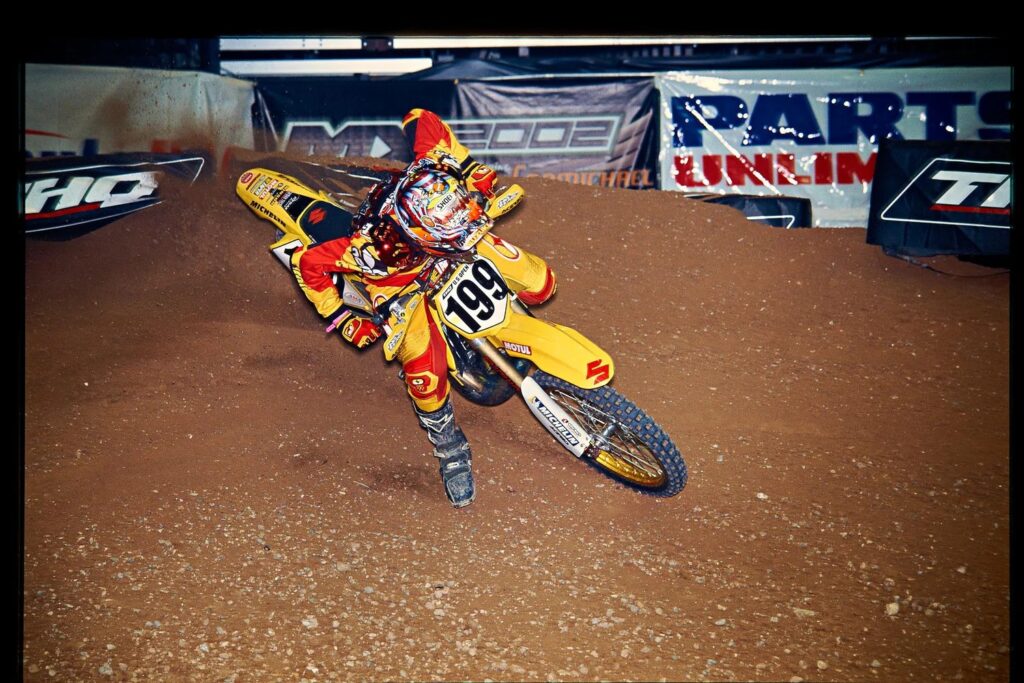
While not every contest between McGrath and Pastrana was headline-grabbing, a few races remain iconic. The 2000 Daytona Supercross saw McGrath maintaining his tactical precision, while Pastrana pushed the limits of aggressive riding. In several heats, Pastrana attempted risky passes that reminded everyone why he was a rising star, but McGrath’s calm, measured approach consistently neutralized those moves. Observers described it as watching “experience versus fearlessness,” and while McGrath crossed the finish line first, the crowd’s roar often went equally to Pastrana.
Another significant moment came during the 2001 AMA Supercross season, where Pastrana’s growing confidence as a racer put him in the spotlight. His daring maneuvers on jumps and corners tested the limits of traditional Supercross tracks. McGrath, aware of the younger competitor, had to adapt his racing style subtly, proving that even the King had to respect the audacity of the new generation. These encounters were less about personal animosity and more about the challenge each represented to the other’s dominance.
Contrasting Philosophies: Consistency vs. Spectacle
The unspoken tension between McGrath and Pastrana was fundamentally philosophical. McGrath thrived on the repetition of excellence; his dominance was built on preparation, technique, and consistency. Pastrana thrived on unpredictability; his greatness came from pushing boundaries and inspiring awe. Fans and commentators often framed their rivalry as a clash between traditionalism and innovation, a dichotomy that mirrored broader debates in sports and entertainment.
This philosophical divide is evident in their respective approaches to media and fan engagement. McGrath became a symbol of Supercross professionalism, maintaining a reputation for focus and discipline. Pastrana, meanwhile, leveraged media, stunts, and viral moments to create a persona that transcended racing. Their rivalry, then, was not just on the track but in the court of public opinion: who represented the future of motocross, and whose legacy would endure?
Influence Beyond the Track
The impact of their rivalry extends far beyond Supercross or FMX. McGrath inspired generations of riders to value technical skill and precision. Pastrana inspired a culture of innovation and fearlessness. The tension between their approaches created a dynamic that pushed the sport forward, influencing bike design, track construction, and event presentation. Without McGrath’s standard of excellence, Pastrana’s feats might have seemed reckless. Without Pastrana’s audacity, McGrath’s dominance might have appeared sterile. Together, even indirectly, they elevated motocross to new heights.
Their influence is evident in the careers of riders who followed. The likes of Ryan Villopoto, Chad Reed, and Josh Hill drew inspiration from McGrath’s consistency, while contemporary FMX stars such as Brian Deegan and Nate Adams pushed the envelope in ways pioneered by Pastrana. In many ways, the McGrath-Pastrana rivalry created a dual blueprint for success: mastery of technique and mastery of spectacle.
Mutual Respect Amid Competition
Despite the media often framing their relationship as a rivalry, McGrath and Pastrana have consistently expressed respect for each other. Interviews reveal admiration rather than animosity. McGrath has praised Pastrana’s fearlessness and innovation, acknowledging how his daring stunts brought attention and energy to the sport. Pastrana, in turn, has acknowledged McGrath’s precision and consistency as a benchmark for excellence. Their rivalry was less about personal conflict and more about mutual recognition of talent and impact.
This respect underscores why their rivalry is so compelling: it transcends ego and drama. It’s a study in how two athletes can dominate in entirely different ways, challenge each other indirectly, and leave lasting legacies without ever needing to clash in a traditional sense.

Legacy: Two Paths to Immortality
Today, the McGrath-Pastrana rivalry is remembered as a defining chapter in motocross history. McGrath’s legacy remains rooted in Supercross championships, unparalleled consistency, and a blueprint for racing excellence. Pastrana’s legacy lives in X Games victories, groundbreaking stunts, and the popularization of FMX, showing how extreme sports can captivate audiences. The beauty of their unspoken rivalry is that it created a narrative richer than wins and losses; it told a story of evolution, ambition, and the eternal tension between mastery and innovation.
In retrospect, the rivalry between Jeremy McGrath and Travis Pastrana was never about animosity. It was about the collision of two visions for what motocross could be. McGrath brought order, precision, and domination. Pastrana brought chaos, creativity, and spectacle. Together, they defined an era, challenged each other’s limits, and inspired generations of riders and fans alike. Their story reminds us that some rivalries are measured not by head-to-head scores but by the lasting influence each competitor imprints on the sport.
In the annals of motocross history, McGrath and Pastrana stand as titans—not because they always raced each other—but because they represented two sides of the same coin: the pursuit of greatness in its many forms. Their unspoken rivalry is a testament to the idea that competition can be as much about respect, legacy, and inspiration as it is about crossing the finish line first.